
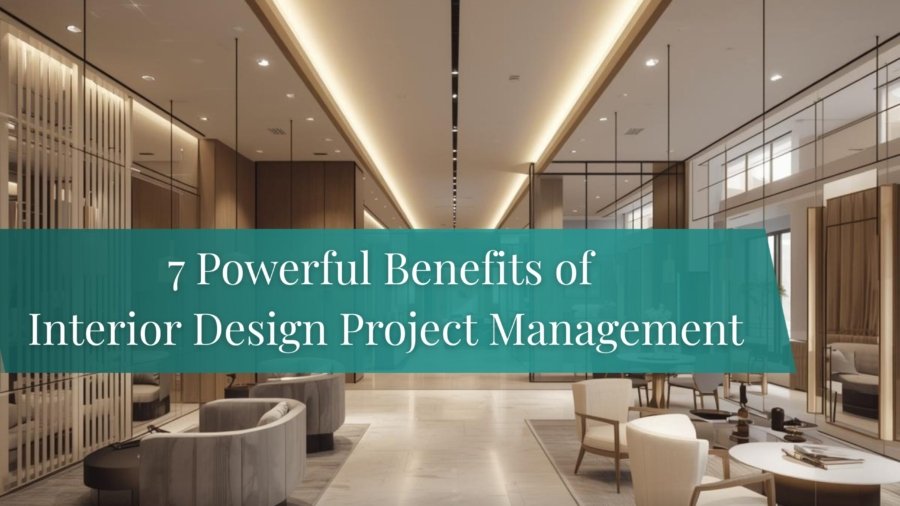
interior design project management

7 Powerful Benefits of Interior Design Project Management

7 Powerful Benefits of Interior Design Project Management for Businesses in the UAE & GCC

Introduction

Managing an interior design project is no longer considered an optional consideration; rather, it is an important strategic consideration for all serious companies wishing to design and create a high-performing business environment. With an increasingly discerning customer base, particularly in the UAE and GCC region where quality is expected and regulated; along with shortened timeframes; failing to properly manage an interior project can damage the perception of a business’s brand and slow down the generation of revenue from the outset.

Whether you are designing a hair salon located in JLT, a specialty retail store in a shopping center, a corporate office, a medical practice, or a café located within a busy area; the decisions made regarding an interior space will fundamentally impact the experience provided to the customer, employee productivity, operational efficiencies and ultimately the value of the company brand. Despite this, many companies still approach the design of an interior space as a single independent creative process rather than as an internal design project management process that combines strategy, design, approvals, construction, budget management, and final delivery to clients.

Mashrou Group works with clients throughout every phase of the interior design project management process, from the initial concept and feasibility, to the detailed design, technical documentation, approving authorities’ coordination, implementation, construction, and final delivery. This blog will identify why managing the interior design project is a business necessity; identify common mistakes businesses make in managing an interior design project; and demonstrate how the implementation of a structured management approach will convert the design of an interior into quantifiable business values.

“interior design project management for modern UAE salon and office space”

Summary – Key Insights

  • Business owners are becoming increasingly aware of how interior design impacts their financial performance, customer satisfaction, and image.
  • Inside the UAE/GCC region, it is very important to combine your interior design with the appropriate building codes, MEP systems, and Leasing/Landlord obligations.
  • By utilizing structured and systematic management techniques for their interior design projects, these businesses reduce risk, control cost and open sooner.
  • With Mashrou Group, decision makers will have one single point of reference, from the idea stage through to the day that they open.

What Is Interior Design Project Management?

Interior design project management is the organization of all components needed to convert an empty area or an existing location into a designed environment. This does not simply involve the design; it also entails:

  • Planning a business’s and/or an individual would be the foundation for Space Planning and Functionality
  • Technical Designs (Mechanical, Electrical, Plumbing); Lighting and Finish – All Technical Design Elements must be approved by the appropriate authorities
  • Budgeting and Controlling Project Costs
  • Coordinating Contractors and Suppliers for Successful Completion
  • Completing the Project Including Final Walk-Throughs with Clients

The Interior Design Project Management approach gives clients a single point of contact and accountability through the Mashrou Group. There is no need for a client to work with multiple individuals (i.e., the designer, contractor, approver or supplier) to manage a project.

Common Mistakes Businesses Make Without Interior Design Project Management

  • People treat interior design as decoration, not a means to create strategic use within the space.
  • Designers and contractors are typically hired separately, without any communication or coordination between them.
  • Construction begins prior to completion of final drawings and obtaining the proper approvals.
  • Forgetting to allow for sufficient time for landlord and municipality’s, civil defense, and other authority’s approvals before starting construction.
  • Material selection without knowing ongoing maintenance and lifecycle costs.
  • Approving designs that appear aesthetically pleasing in design however do not maximally support operations of the company.
  • Not developing flexibility in order to utilize for future growth and/or changing service needs.
  • These issues can be mitigated by implementing project management for interior design from its inception.

Why Interior Design Project Management Matters in the UAE & GCC

Commercial properties in the United Arab Emirates and on the Arabian Gulf Coast are not built in isolation but exist within ecosystems such as malls, office towers, mixed-use developments and hyper-competitive retail/hospitality clusters. A salon located in Dubai’s Jumeirah Lakes Towers has competition from multiple beauty salon concepts within walking distance. Similarly, a café located at Dubai Marina has competition from dozens of food/beverage brands for views and engagement on social media, as well as time spent in-venue. Office spaces located in business towers are competing for talent and employee productivity.

In this highly competitive marketplace, managing an interior design project becomes an even bigger competitive advantage since it allows for systematic linkage between business drivers and physical spatial deliveries.

Therefore, the first step of an effective project management process is to analyze the business model: What types of services will be offered? What is the average number of customers per hour? What is the expected level of privacy for clients? How many employees will be greeting customers each day? What are the expected peak times? How is the brand being priced and positioned: Is this a luxury, mid-market, or accessible brand?

After gathering all this information, the interior design project manager can move to develop specific spatial approaches, such as zoning, circulation patterns, functional layout, etc.: Where to physically locate reception areas? How do clients navigate through the space? How do staff members perform their job functions? What are the storage areas? How does the “back-of-house” interact with the “front of the house”? How does each service component (such as HVAC, lighting, MEP) provide for customer comfort and worker efficiency?
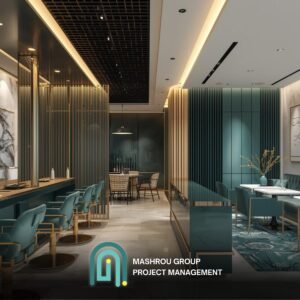
interior design project management for UAE businesses

The regulatory layer is the one that will require the most approvals in the UAE/GCC, and each sector has different approval requirements (salons, clinics, F&B, offices, and retail are all different). Each sector has a different set of standards that relate to ventilation, hygiene, fire safety, plumbing, accessibility, and signage—all of these areas will be affected when designing a project without having a structured interior design project management process.

The cost pillar is another critical pillar. Many businesses have an overall project budget in mind, but they do not have a detailed cost breakdown. Interior design project management is a system that gives you the framework for creating a cost plan for your project. Your cost plan should include all materials, finishes, lighting, furniture, joinery, equipment, contingency, authority fees, professional fees, and any other landlord requirements. As a result, your decision-makers can make adjustments to their scope and specifications based on their priorities instead of becoming aware of overruns after the project is already in progress.

The success or failure of most projects lies in the execution. With a solid concept and approved drawings, however, if a project does not have a responsible manager overseeing the timelines, quality, and coordination on-site, the actual completion of that project will drift from what was originally established as the intended outcome. When Mashrou Group is the project manager for an interior design project, we bring together the design intent and the execution, by monitoring the progress of the project, resolving any conflicts, reviewing the shop drawings, checking the samples, aligning subcontractors, and ensuring that what is built meets the promises made to the client, both visually and technically.

The handover process is a crucial step that is frequently overlooked by many contractors/clients. It consists of many other things than just handing over the keys – e.g., snagging, system testing, training staff on how to use the built space and equipment, providing the client with documentation, as-built drawings etc. A comprehensive interior design project management process also ensures that there is a structured way of closing the project so that the client can hit the ground running from day one.

The results of that? Clients will have spaces that feel coherent, efficient and on-brand. Clients will have projects that open on time (instead of weeks or months late) and will have protected their investments (instead of losing them through poor planning). Business owners will experience less stress, less uncertainty, and be able to focus more on their customers and their businesses’ future.

Features – What Mashrou Group Brings to Interior Design Project Management

Feature 1 – A Single Source of Accountability

Mashrou Group serves as a central source of accountability providing a single point of reference for clients to manage the entire interior design project through the entire process from concept design through to final inspection and acceptance of the completed project. This takes away the uncertainty and confusion often created by multiple contractors working on a project.

Feature 2 – This is Not Just About Aesthetics – Interiors are Strategic

We do not look at interiors as simply a piece of decoration. We provide an integrated approach to project management of your interior spaces, aligning your workspace with the company’s brand strategy, customer experience and operational workflows and generating revenue to support your operating budget. Every square meter of your space is specifically designed for the purpose of generating revenue or providing support for your employees.

Feature 3 – Local Knowledge and Regional Experience Matters

Mashrou Group is familiar with the authorities within the UAE and the GCC and their requirements, as well as the expectations of the landlords within the market. Clients who use Mashrou Group’s project management services avoid costly mistakes, as well as the slowdowns and redesigns often caused by inappropriate or poorly executed global concepts being applied to the local market without proper consideration for local customs.

Key Benefits of Interior Design Project Management

Aligning the design of your space with your company’s goals will provide you with the following benefits:

  • Improved cost control and budget visibility
  • Faster review/approval process and better coordination of management oversight
  • Reduced exposure to project delay and re-work
  • Greater brand influence on the customer experience
  • Better communication among the design team, M.E.P., and finishing contractors
  • A structured method to track snags and complete the building handover process

All of the benefits above are achieved as a direct result of utilizing professional project management to oversee your company’s interior design projects.

Project managers reviewing interior design drawings

Strategies to Get the Most from Interior Design Project Management

  • Start EarlyPrior to executing a lease agreement or making a final decision regarding the rented space, it is wise to work with the Mashrou Group interior design Project Management team to define the feasibility of the interior design layout and to maximize the efficiency of the layout.
  • Define Your PrioritiesAre you most concerned with operational efficiency, the brand experience you want to create, your budget or speed to market? Establishing a hierarchy of priority to make trade-off decisions on interior design can aid you greatly with these types of decisions.
  • Think in terms of the Customer JourneyIn the case of salons, clinics, cafés, or retail stores, you should create a visual representation of how customers will enter and exit your facility, along with how long they will have to wait and how they will pay for their goods or services. The Mashrou Group uses the Customer Journey as the basis for developing layouts for our clients’ facilities.
  • Consider Lifecycle Costs, not just Fit-Out Costs.At times, a client will select materials that are less expensive to purchase but much costlier to maintain. We help you maintain a balance between aesthetics and durability.
  • Plan for Future ExpansionInterior design can support or facilitate future expansion into new service lines, technology or additional physical space if it is appropriately considered in the early stages of the project planning process.According to research on workspace design and productivity, layout and environment significantly affect performance

Conclusion

The United Arab Emirates and Greater Gulf Cooperation Council (GCC) region represent an extremely competitive market driven by customer experience, where the interior of your business is the platform upon which you will build your operation. Interior design that creates an energized environment reinforces your brand, streamlines your operational functions and keeps your customers returning to your business. Conversely, poor interior design slowly diminishes your profitability and your reputation.

Interior design project management is the process by which creative concepts are transformed into functioning reality through the effective integration of your business strategy, design development, approvals, project cost control, project implementation, and project handover. By utilizing Mashrou Group’s extensive experience with interior design project management, you will avoid the many trap doors that can occur throughout the project and allow your concept to reach its maximum potential.

If you are planning a salon, medical practice, office, café, retail establishment, or any other type of commercial project in the UAE or GCC, it is essential that you partner with a company that understands the importance of Interior Design Project Management; this provides you with a competitive advantage from the start.

Learn how we manage feasibility and risk in our [Feasibility Studies for New Businesses] blog.

FAQ

The process for managing the interior design of a building (including the construction or alteration of the interior of any structure, as well as any necessary accessory spaces) is an organized series of steps in which the client, designer, engineer, contractor, supplier, and building authority work together to ensure that all the parts of the project come together successfully, from initial concept through final handoff. In this way, the design and construction achieve business, brand, and operational requirements.

Due to strict regulations regarding approvals and landlord requirements, the UAE/GCC countries have a need for careful management of interior design projects. If businesses do not follow the proper processes, they may face delays in receiving approval from the appropriate authorities and/or be forced to pay significant costs associated with environmentally friendly retrofitting to comply with building regulations.

The Mashrou Group provides complete interior design project management services, including concept design, development of technical drawings, coordination with MEP engineers and local approval authorities, management of the fit-out process, and final handoff.

No! Every type of space—whether it be a small salon, clinic, café, or boutique—benefits from project management for interior design because of how effective it will be on layouts, the approval process, so the project is completed on schedule; the budget and ultimately when you can open.

Contact us to arrange an initial conversation about the type of business you want to create, its location, when you would like to launch, your budget, and what you expect from us in regards to the project management of the interior design. Then we create a plan for managing your interior design project following your unique requirements.

Let’s Build Your Next Project with Confidence

Partner with Mashrou Group to plan, manage, and deliver your project with clarity, control, and measurable results.


Connect With Us

Follow our latest updates, projects, and insights across our social media platforms. Stay connected as we continue to deliver innovation and excellence.

business planning mistakes before starting a new business UAE feasibility study

5 Strategies to Avoid Common Business Planning Mistakes Before Starting a New Business in the UAE

Common Business Planning Mistakes Before Starting a New Business
(UAE/GCC Market)
A Strategic Guide for Informed Decision-Makers

Introduction

Business planning mistakes before starting a new business are one of the main reasons new ventures fail in the UAE and GCC markets. These business planning mistakes often occur during feasibility, compliance, financial modeling, and branding stages, before the project enters execution. While the region offers opportunity, many entrepreneurs enter without feasibility, compliance planning, financial modeling, or branding strategy. This guide explains the most critical mistakes early founders make and how structured planning reduces risk.

Starting a business is an attractive option for many entrepreneurs, investors, and businesses from around the world in the GCC or UAE region. There are numerous favorable factors including a strong consumer demand base, world-class infrastructure, attractive tax structures, and an abundance of investor confidence. Unfortunately, despite the assistance of the many economic advantages the region gives to business, a large percentage of newly formed businesses fail, within 3 years of their establishment, as result of mistakes made during their formative stages that could easily be avoided.

Based on our experience working with founders, investors, small, medium and large business clients, we have identified the most significant source of businesses’ failures prior to opening their doors, that is, the lack of sufficient strategic readiness prior to the opening of the business. The main causes of the most costly failures of newly created businesses prior to their opening are:

  • Misjudged demand
  • Inadequate financial planning
  • Regulatory errors
  • Poor brand positioning
  • Inconsistent execution of projects.

This article identifies the most common types of mistakes made in the business planning process before establishing a new business and it combines the global entrepreneurship perspective (G) and the realities on the ground in the GCC/UAE region. For business leaders that want to determine if to invest their capital, this guide positions Mashrou Group as a strategic partner supporting:

  • Feasibility study development
  • Document clearance
  • Brand development
  • Project Management
  • Turnkey fit out services

In conclusion, the purpose of this article is to help business leaders, reduce risk and make confident decisions by avoiding common business planning mistakes when establishing a business.

Confidence in Decision-Making

Summary – Key Insights

  • The majority of successful businesses do not come about because someone got lucky—the majority of success comes from being informed, making wise choices and following through.
  • Most failures can be predicted based on indicators such as market gaps, financial difficulties, regulatory obstacles, time-consuming processes and branding issues.

Understanding and avoiding business planning mistakes early increases the probability of a successful launch and reduces investor risk.


  • The UAE/GCC markets require detailed and complete feasibility studies, compliance readiness, and strong value propositions.
  • By offering a complete suite of services, Mashrou Group can take entrepreneurs through a smooth transition from their initial idea through the analysis and approval stages to ensure they have everything they need to execute successfully.

Common Business Planning Mistakes Before Starting a New Business

1. Starting with no Feasibility Study is the Most Common Mistake and Most Costly Mistake

The biggest and most damaging mistake many founders make is that they rely on their gut instinct instead of having hard evidence to make their decisions. A Feasibility Study can validate the following aspects of your business:

  • The market demand.
  • The operational viability.
  • The financial sustainability.
  • The exposure to risk.
  • The time to break-even.

In the UAE, a Feasibility Study is both strategic and often used by potential investors, or for internal approval or licensing.

2. Entrepreneurs tend to under-estimate Capital Needs

When you plan your Capital Requirements for your start-up, many entrepreneurs tend to think only about start-up costs, without thinking about all of the following:

  • Operating Expenses
  •  Working Capital
  •  Delay Impact
  •  Vendor Differences
  •  Licensing Renewal

The result is usually that the business owner has left themselves open to mistakes in Business Planning and beginning business, especially in areas with stiff competition.

3. “Everyone is a Customer” is a False Assumption

Any business owner that does not develop a Segmented Customer Strategy could potentially cause:

  • An in-correct Marketing Strategy
  •  An inconsistent Brand Identity
  •  A Waste of Advertising Budget

Consumers in the UAE typically respond to clear distinctions between products and services by budgeting, luxury products, budget products, niche products and experiential products.

Business-Transform

4. Weak Brand Positioning

Without Strategic Branding for Your Business:

  •  Customers will be unable to distinguish you from your competitors
  • It will be difficult to demand a premium price on your product
  • The ROI on your brand marketing will be lower

Branding is not just a Logo; Branding is an identity of your company in the market.

5. Overlooking Documentation and Regulatory Requirements for Business Establishment (UAE/GCC)

  • Each jurisdiction has certain rules and regulations that govern how businesses can be started, such as:
  • Free zone (vs. mainland)
  • Visa quotas
  • Activity approvals
  • External regulatory approvals (NOCs)
  • Municipality regulations

Lack of planning for compliance will ultimately lead to delays in the start-up and increased launch costs.

6. Lack of Clarity Regarding Revenue Model or Business Model

  • If you don’t clearly understand where revenue will come from, then you cannot scale your business.
  • Questions often go unanswered:
  • What is the source of cash flow?
  • What is the pricing model?
  • How does volume affect profit?

7. Delaying Marketing until Later Stages of the Business Lifecycle

Marketing isn’t a ‘later step’ in your business plan; it is part of your business planning. Businesses that wait to begin marketing will experience slower traction and higher costs associated with launching their business.

8. No Operational Execution Plan

An operational execution plan outlines the staffing plan, procurement plan, fit-out plan, schedule, and workflow. Many businesses in the UAE lose traction because they do not provide oversight of their execution.

9. Selecting Poor Contractors and Vendors

  • Selecting lower-priced vendors will typically lead to:
  • Delays
  • Change Orders
  • Re-work
  • Lower Quality Results

Mashrou offers a complete project management service, which we provide by overseeing all aspects of contractor selection, fit-out, and delivery to ensure that your project stays on schedule.

10. Ignoring the Need to Perform a Risk Assessment

  • While risk can be quantified, many founders do not give importance to risk.
    Common risk factors include:
  • Regulatory
  • Market
  • Financial
  • Operational
  • Competitive

Highlights – Quick Reference

  1. Before investing in a new venture, validate the demand for it.
  2. Familiarize yourself with the legal framework in the UAE (i.e., a government issues business licences).
  3. Create various financial models including alternative and worst-case scenarios. Invest in creating a strong brand identity from day one.
  4. Develop an implementation checklist. Approach the execution of the new enterprise like a corporate professional.
  5. Learn business plan development mistakes in advance of launching a new business.

Understanding the Importance of Strategic Planning

Feature 1 – Aligning with the UAE Market

The UAE business environment both incentivizes and rewards companies that utilize a data-driven, compliant structure. The feasibility study will help to ensure that your vision is compatible with the local regulatory, financial, and commercial environments.

Feature 2 – Full Lifecycle Integration

Mashrou Group will support all phases of the life cycle within a project, including the ideation, viability assessment, document clearance, branding strategy, project management, execution of interiors, and the eventual transfer of the project to the owner.

Many of these business planning mistakes can be mitigated by structured feasibility studies and strategic market research.

Feature 3 – Confidence in Decision-Making

By utilizing a structured approach to insight, providing measurable forecasts, and dealing with risks appropriately, business owners and executives will have greater confidence in making decisions related to their projects and ventures.

Understand UAE legal structure before selecting license type.

There is an opening in the UAE/GCC market for entrepreneurs to launch a new business. However, as capital may be lost through the execution of an idea, creating a business requires proper strategic planning. The uncertainty that surrounds whether a new venture will succeed or fail is mitigated with feasibility studies. Through Document Clearing Services, it is ensured that the business complies with actual and local laws.

Brand Development is used to develop customer perception. Therefore, Project Management entails plan execution. Fit-out and Handover of a building is another key area of Project Management; through this, you ensure that a business is operational before commencing operations. By identifying business planning mistakes before capital is deployed, Mashrou Group helps reduce uncertainty and accelerate time-to-market.

Mashrou Group works through all these layers. We begin with conducting feasibility studies – Market Analysis, Financial Modelling, Break-even Assessments, Capital Assessments, and Scenario Planning. We then offer Document Clearing Services for all jurisdictions involved in your business. After validating the business foundation, we develop a Brand and Market Positioning, Marketing Strategy, and Value Proposition.

After all that is completed, Project Managers will provide guidance on Technical Drawings, Contractor Coordination, Procurements, Timelines, Milestones, and Budgeting. The execution and fit-out services we add at this stage allow for precise delivery of your business.

We do not just help our clients avoid mistakes made in their business planning before starting a new business, but we also help them develop a business that is clear, resilient, and has long-term profitability. When our clients work with Mashrou Group, they achieve Operational Visibility, Financial Predictability, Regulatory Compliance, and Strategic Alignment, which serves to improve Investor Confidence, Protect Capital, and Accelerate Time-to-Market.

Entrepreneurs that do not complete a Feasibility Study assume what they think is valid but often figure out  they were wrong. These patterns reveal how business planning mistakes affect cost, timing, and investor confidence. Entrepreneurs that do not use Strategic Branding rely on luck to establish their business. Entrepreneurs that decide to control the document clearing process by themselves within the United Arab Emirates experience delays. Entrepreneurs that hire contractors for the lowest price often end up with twice as many hours spent on rework. Entrepreneurs that ignore external market dynamics are unable to achieve fast traction within the marketplace.

All businesses that experience success within the UAE follow the same sequence of events:
Clarity → Structure → Compliance → Strategy → Execution → Growth

Mashrou Group provides the entire process from beginning to end.

In the UAE/GCC ecosystem, business planning mistakes are rarely caused by luck — they stem from a lack of structure, validation, and compliance.

Conclusion

The majority of business planning mistakes that entrepreneurs make before launching a new business can be avoided. With structured Feasibility Studies, Strategic Branding, properly prepared and completed documentation, and disciplined Project Management, business owners have the best chance to position themselves for success in the UAE/GCC for many years to come. The Middle East rewards businesses that have taken the time to prepare, validate, and execute plans using precision and accuracy. Mashrou Group guarantees that business owners will not be alone on their journey to success.

End to End Business in UAE

Opening a Cafe in Dubai

FAQ

Feasibility studies help confirm there is market demand, that the business will be financially feasible, that there are risks involved and that the business can operate as planned.

Errors include not completing a feasibility study, weak financial planning, compliance errors, improperly constructed branding and “willy-nilly” implementation of the business.

Assistance includes conducting feasibility studies, clearing documents for export, creating branding, managing projects, and providing full implementation services.

Yes; we provide full documentation support for businesses wanting to set up in the mainland, free zone, and offshore.

Branding affects how consumers view your company, builds confidence, and influences their buying decisions.

Let’s Build Your Next Project with Confidence

Partner with Mashrou Group to plan, manage, and deliver your project with clarity, control, and measurable results.


Connect With Us

Follow our latest updates, projects, and insights across our social media platforms. Stay connected as we continue to deliver innovation and excellence.